AI Call Center Transformation in HVAC: How Rescue Air and Avoca AI Are Redefining Booking Performance and Call Center Leadership for 2026...

In this Power100 PowerChat, CEO Greg Cummings sits down with Rescue Air owner Josh Campbell, Avoca AI founder Tyson Chen, and Rescue Air operations manager Andreas Bouras to reveal how turning AI from a side experiment into the backbone of the call center—answering calls, texts, chats, and bookings within seconds, grading every interaction, and freeing leaders to “quit running a call center” and focus on the trades—gives HVAC and home service companies the operational efficiency, booking precision, and leadership leverage they need to win in a tighter 2026 economy.
The PowerChat series, hosted by Greg Cummings, brings together top operators, founders, and industry leaders for honest conversations about what is really shaping the home services market. Each discussion is built to challenge thinking, highlight innovation, and give contractors clear insight into what is working at a high level. In this featured episode, Greg sits down with Josh Campbell, Owner of Rescue Air, Tyson Chen, Founder of Avoca AI, and Andreas Bouras, Operations Manager at Rescue Air, to explore how artificial intelligence is reshaping call centers and preparing companies for a tighter economy.
“Power100 is the only unbiased third-party platform that recognizes and elevates the top leaders and most impactful companies in the home improvement industry.” Through conversations like this PowerChat, Power100 continues to spotlight CEOs and founders who are not waiting for change but leading it. The discussion between Rescue Air and Avoca AI reflects the kind of strategic thinking and disciplined leadership that is raising the bar across the industry.
This PowerChat was built around one clear purpose. To explore how strong leaders are using artificial intelligence to improve performance, protect margins, and prepare their companies for a more competitive market. Hosted by Greg Cummings, the conversation brought together Josh Campbell of Rescue Air, Tyson Chen of Avoca AI, and Andreas Bouras to unpack a topic many contractors are thinking about but few are fully embracing.
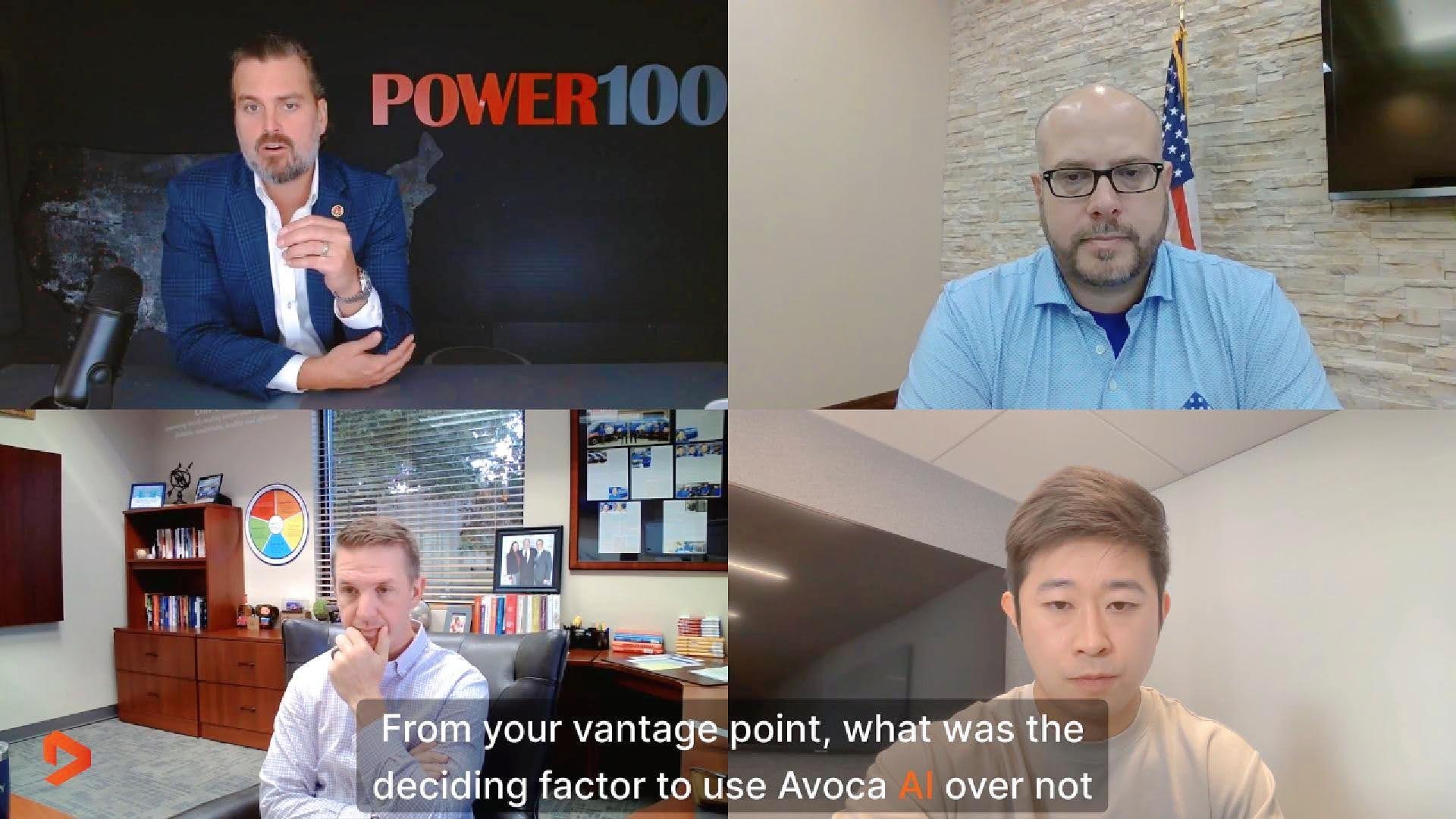
At the center of the discussion was the call center. For years, home service companies have treated the call center as just another department. But in reality, it is the front door to revenue. Missed calls, slow response times, and poor booking habits cost companies thousands of dollars every month. As Josh Campbell shared during the interview, many contractors are trying to run a call center while also running an HVAC or plumbing business. That split focus creates cracks in performance.
The conversation focused on how AI is changing that dynamic. Through Avoca AI’s platform, Rescue Air has integrated artificial intelligence to handle calls, texts, chats, and scheduling support. The goal is not to remove people. The goal is to remove friction. By answering calls faster, offering homeowners more options, and coaching staff with real performance data, AI becomes a tool for precision and growth.
This topic matters right now more than ever. The home services industry is entering a tighter cycle. Competition is increasing. Booking rates are becoming harder to secure. Equipment costs are rising. Growth expectations are more disciplined than in previous years. In this climate, operational efficiency is no longer optional. It is survival.
This PowerChat is for contractors who feel the pressure of a changing market. It is for owners who want better systems, not just more hustle. It is for leaders who understand that technology alone does not create results, but disciplined leadership combined with the right tools can change everything.
Listen in on the PowerChat: “That Is Not At All How It Went Down But A Little Bit..” | Tyson, Josh and Andreas PowerChat Part 1
As the conversation unfolded, one message became clear. Artificial intelligence is no longer something contractors test on the side. It is becoming part of the core structure of serious companies.
Josh Campbell shared that his team has always leaned toward early adoption, not for the sake of hype, but for performance. “AI is coming. It is not like it is coming. It is here,” he said plainly. For him, the question is no longer whether to use AI. The question is how deeply it should be integrated.
Through its partnership with Avoca AI, Rescue Air began using AI to handle calls, texts, chats, and booking logic. What started as curiosity became infrastructure. The system does not get tired. It does not call in sick. It answers within seconds.
Founder Tyson Chen explained that the goal was never to create a flashy product. It was to build a system that contractors could rely on daily. “Any successful rollout requires buy in,” he shared. “It is leadership that makes the difference.”
In this way, AI shifts from being a test tool to becoming the silent engine behind consistent revenue capture.
One of the most powerful moments in the interview came when Josh described the reality most contractors avoid talking about.
Home service companies are trying to run a call center inside a trades business. And most are not getting it right.
Josh referenced the hedgehog concept. Stay in your lane. HVAC companies fix systems. Plumbing companies solve water problems. But call centers are a business of their own.
“We are trying to do call centers while running our companies,” Josh explained. “And we have never gotten it right.”
Missed calls. Inconsistent training. Staff turnover. After hours services that promise help but fail to book. These are quiet leaks in revenue that often go unnoticed.
Andreas Bouras oversees operations at Rescue Air, including the call center. He described life before AI as reactive. Staffing gaps created stress. After hours calls did not always convert. There was no true safety net.
“Life is better,” Andreas said simply. “I do not panic anymore when someone quits. I know we have Avoca. We can handle it.”
The crisis is not dramatic. It is operational. And for companies that ignore it, it slowly drains performance.
The conversation then turned outward, toward the homeowner.
Consumers today want speed. They want options. They want less friction.
Through Avoca’s integration, Rescue Air gives customers the choice to speak with a person, interact with AI, or book through chat. What surprised many viewers was the adoption rate. About half of customers choose digital options.
“There is definitely a higher trend,” Andreas explained. “People are glued to their phones. They want to text in, book service, and move on.”
Tyson added that one positive AI interaction can permanently shift perception. In the past, automated systems frustrated people. Today, when they work well, they feel efficient.
The race is no longer just about who answers the phone. It is about who books the fastest. And in that race, seconds matter.
As the discussion moved toward the broader market, the tone became practical.
Competition is increasing. Booking rates are tightening. Equipment costs are rising. Growth expectations are more realistic than in past years.
Josh was direct about 2025 planning. “I seriously doubt we are putting down 35 percent growth,” he said. “If you are flat, you are probably not in a terrible spot.”
That honesty reflects a shift across the industry. The focus is no longer growth at any cost. It is margin protection and operational discipline.
Greg Cummings highlighted a simple but powerful truth. Answer the phone three seconds faster and booking rates increase. Small operational gains compound into major revenue impact.
Tyson also shared a trend he is seeing across the industry. “Booking rates have gone down a bit because it is more competitive,” he explained. “You actually need better salespeople. You need tighter discipline.”
Efficiency is no longer a luxury. It is the line between surviving and scaling.
Throughout the entire PowerChat, one theme held steady. Technology does not fix companies. Leadership does.
Tyson credited Rescue Air’s success to its involvement in implementation. The team worked through scheduling logic, call grading, and feedback systems. They shaped the tool to fit their operation.
“It is the leadership starting from the top,” Tyson said. “That level of culture and buy in is critical.”
Josh echoed that mindset when speaking about companies freezing software investment during tighter economic times. He believes cutting innovation out of fear is short sighted. Instead, strong leaders sharpen their tools.
“Quit running a call center. Let somebody who does it at a high level do it for you,” Josh advised.
The message was clear. AI is powerful. Systems are powerful. But disciplined leadership is what turns tools into transformation.
Listen in on the PowerChat: “Life Is Better – Let’s Sum It Up To That…” | Tyson, Josh and Andreas PowerChat Part 3
As the PowerChat moved from philosophy to execution, the spotlight naturally turned to the platform itself. Avoca AI is not simply an answering system. It is a responder and coaching platform designed to solve one of the most persistent problems in home services. Inconsistent booking performance.
The responder platform handles inbound calls, texts, web chats, and lead sources around the clock. It answers within seconds. It gathers the right information. It follows scheduling logic. Most importantly, it books appointments with precision. For HVAC companies that process thousands of calls each month, even small improvements in booking rates translate into significant revenue gains.
But the real long term value lies in the coaching layer. Every call can be graded. Every interaction can be reviewed. Instead of guessing whether a CSR handled a call well, leaders now have measurable insight. They can see what works. They can correct what does not. They can raise the standard across the entire team.
Tyson Chen described this approach as discipline at scale. The system does not replace human talent. It strengthens it. By creating clear scoring and feedback, companies build a culture of accountability and growth.
For HVAC leaders preparing for a more competitive 2025, this is not just helpful. It is strategic. As margins tighten and consumers expect faster service, companies must capture every opportunity. The responder platform protects revenue at the front door. The coaching platform strengthens performance behind the scenes.
The forward outlook is clear. Call centers will no longer operate on instinct alone. They will operate on data, speed, and structure. Companies that embrace this shift now will enter the next market cycle with confidence. Those that wait may find themselves reacting instead of leading.
Listen in on the PowerChat: “Stop Hiring New Ones – That’s Stupid…” | Tyson, Josh and Andreas PowerChat Part 4
This PowerChat was more than a discussion about software. It was a reflection of where the home services industry stands today.
Markets tighten. Margins shift. Consumer expectations rise. In moments like these, leadership is tested. Some companies respond with fear and freeze progress. Others respond with courage and sharpen their systems.
The conversation between Josh Campbell, Tyson Chen, and Andreas Bouras showed what disciplined leadership looks like in real time. They did not frame artificial intelligence as a replacement for people. They framed it as a partnership.
AI answers faster. AI processes data. AI protects opportunity.Humans build trust. Humans solve problems. Humans lead culture.
Together, that combination becomes powerful.
“In a tougher economy, you have to make smarter choices,” Josh shared during the conversation. That statement captures the heart of this moment. Innovation matters more when conditions are tight, not less. Efficiency becomes protection. Structure becomes stability.
Through PowerChat, Greg Cummings continues to create space for these honest conversations. By bringing together operators and founders who are actively shaping the future, Power100 is helping contractors think clearly about what comes next.
The path forward for 2025 is not about hype. It is about discipline. It is about leadership. It is about using the right tools at the right level to serve customers better and build stronger companies.
Those who embrace that mindset will not just survive the next cycle. They will define it.
The Inner Circle unlocks every Power100 interview, PowerChat episode, and expert playbook — free for industry leaders.
Power100 is the nation's premier CEO ranking and media platform for the home improvement industry. Using a proprietary 5-layer evaluation system, Power100 identifies and celebrates the top CEOs, companies, and strategic partners driving innovation, customer satisfaction, and leadership excellence across the country.